

Food delivery pricing wars are not won by discounts but are won by superior data.
Have you ever wondered how food delivery platforms decide when to discount and when to surge without disrupting margins or breaking service reliability? In an industry where margins rarely exceed 5%, pricing decisions are no longer tactical choices. They are business-critical.
As a result, food delivery platforms have transformed pricing into a data-driven system powered by pricing intelligence. With increasing competition, platforms are forced to make thousands of pricing decisions across micro-markets every day. Each decision relies on continuous data inputs.
Also, from a B2B standpoint, food delivery pricing wars are not fought in marketing campaigns or promo banners. They are fought in data pipelines, forecasting models, and real-time decision engines. And increasingly, those systems determine which platforms scale efficiently and which struggle to keep margins intact. In this article, we will uncover the actual reasons for pricing wars among food delivery platforms.
When you look at a food delivery app, at first glance, it appears to be a pricing war. Apps competing for discounts, best value products, cashbacks, subscriptions, etc. However, in an industry with thin margins and high logistics costs, competing solely on price is unsustainable.
Pricing has become a strategic tool powered by data. It is no longer about offering the cheapest price. It is about offering the right price for a specific location, time, and customer context. Platforms analyze various data points like current order demand in a specific area, the availability of delivery partners, restaurant preparation capacity, traffic conditions, and expected delivery times. These signals are layered on top of historical patterns that help predict what is likely to happen next.
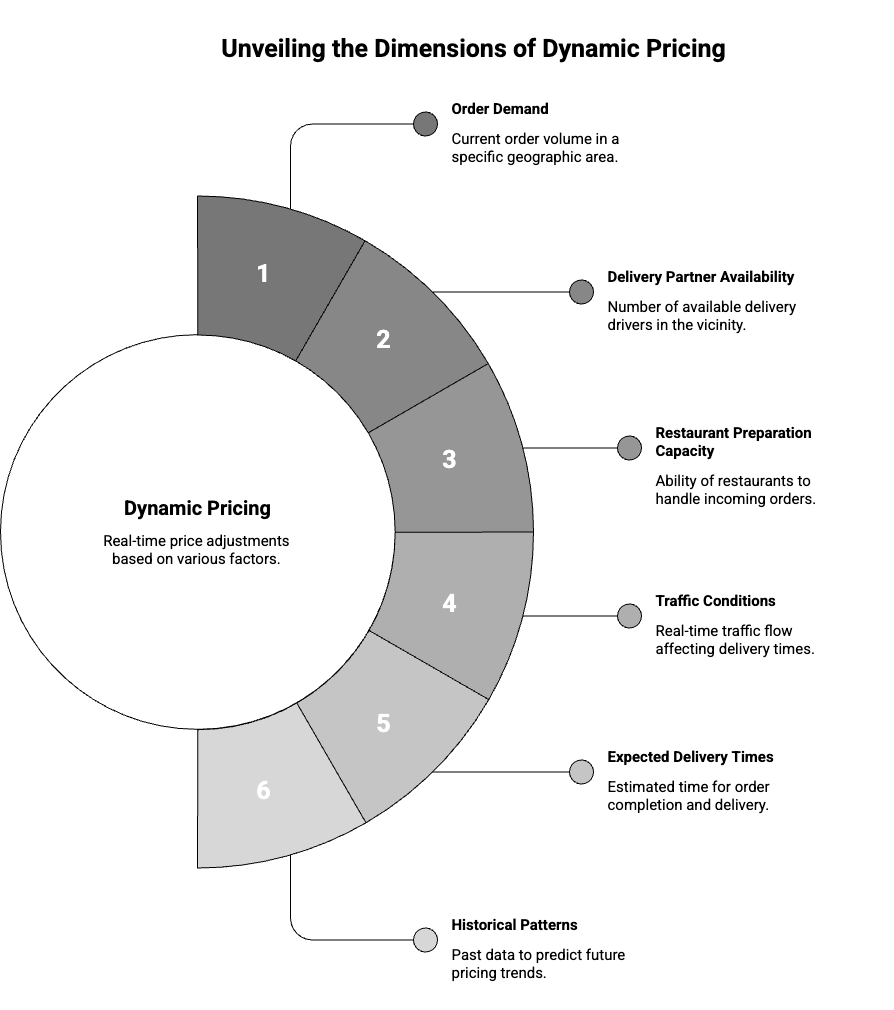
The result is a dynamic pricing system that can respond instantly to changing conditions rather than relying on fixed fees or one-size-fits-all pricing models. Having said that, one thing is clear that, without analyzing a set of data, it is impossible to create a strategy that benefits all.
Discounts on food delivery apps are not blanket giveaways. They are structured experiments. Platforms like Swiggy, Zomato, and UberEats constantly test different types of offers to understand what changes customer behavior. Some promotions are designed to increase order frequency, others to boost average order value, and some simply to prevent churn.
Each discount is evaluated against measurable outcomes, such as whether the user returns without incentives or whether the promotion attracts only deal-driven customers who never become loyal.
If a discount doesn’t improve long-term metrics, it is either modified or removed. In this way, competitive pricing becomes a learning system rather than a static marketing tactic.
The purpose of surge pricing is not simply to increase revenue. Higher fees encourage more delivery partners to log in, helping restore balance in the system and reduce delivery delays. From a data perspective, surge pricing is a coordination mechanism that keeps the marketplace functioning smoothly under stress.
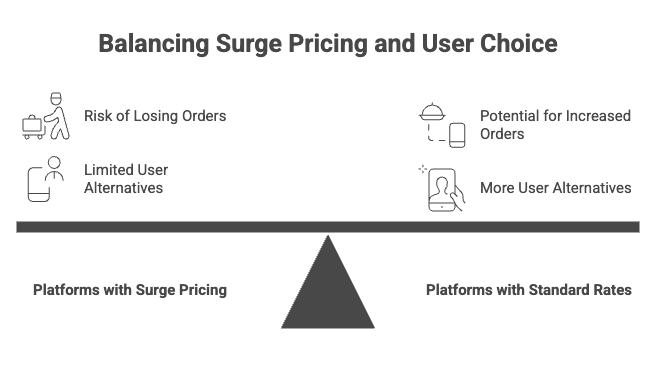
If one food delivery platform implements surge pricing while competitors maintain standard rates, they risk losing orders. However, if all major platforms surge simultaneously, users have limited alternatives. This coordination emerges naturally from similar data inputs and algorithmic responses, but it also shows how data has advantages across networks.
Low prices mean nothing if service reliability suffers.
Delivery platforms with accurate forecasting models can predict demand surges, allocate delivery partners proactively, and manage restaurant load more effectively. This reduces late deliveries, cancellations, and customer dissatisfaction. Data-driven pricing systems improve operational outcomes alongside revenue, including 20% revenue growth and 30% faster sales execution in dynamic pricing implementations.
The platform that consistently delivers in 28 minutes as promised beats the competitor offering 20-minute delivery that actually takes 40 minutes. Achieving this accuracy requires precise data on restaurant preparation times, driver speeds under various conditions, and traffic patterns. Finally, all pricing decisions depend on the quality and reliability of data.
Food delivery platforms are not competing on who can give discounts the most. They are competing on who can collect, process, and act on data faster.
Pricing has become a real-time, data-driven system that balances demand, supply, customer value, and profitability. Ultimately, the platforms that win will not be the ones offering the cheapest or the fastest orders, but the ones converting every transaction into insight.
In the food delivery economy, data is no longer a support function for pricing, it is the strategy itself.